Citrus Greening Panorama 2026/2027 — The Market
Nexus4AI · Original analysis · Data cut-off: October 22, 2026 7-minute read
⏱️ The figures on this page have an expiry date. Futures prices and the price per box change within weeks, and every figure here comes with its date. An example of how much this matters: on September 22, 2026, the price of concentrated orange juice in New York was 36% below its level a year earlier; a month later, on October 22, 2026, it was about a quarter below its October 21, 2025 level. Check the source before making any decision. [1]
Summary
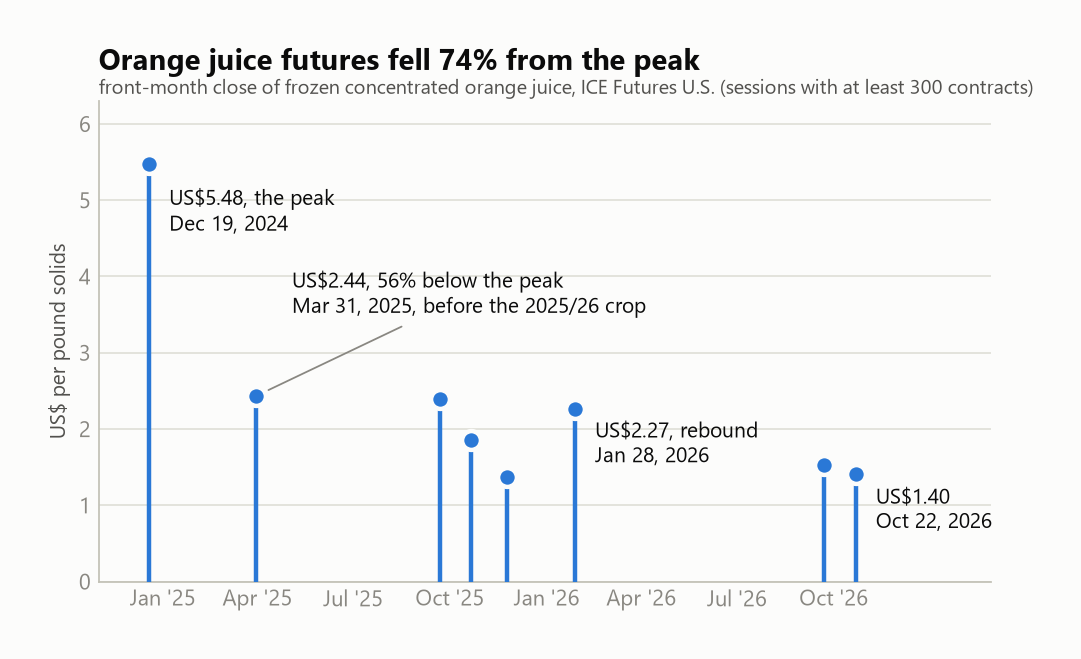
The price of frozen concentrated orange juice on the New York exchange fell 74% from its December 2024 peak: from US$5.48 to US$1.40 per pound solids on October 22, 2026. [1]
Most of the decline came early: by the end of March 2025, the price was already 56% below the peak, before the 2025/26 crop year began. [1] As we read it, the market anticipated the return of supply, which then materialized: the crop in the citrus belt of São Paulo and the Triângulo/Southwest Minas Gerais, which had been 230.87 million boxes in 2024/25, closed 2025/26 at 292.94 million (+26.9%). And, with juice more expensive on store shelves, American consumers kept buying less. [2,3] Since then, the price has swung widely, with a rebound to US$2.27 in January 2026, but it has not returned anywhere near the peak. [1]
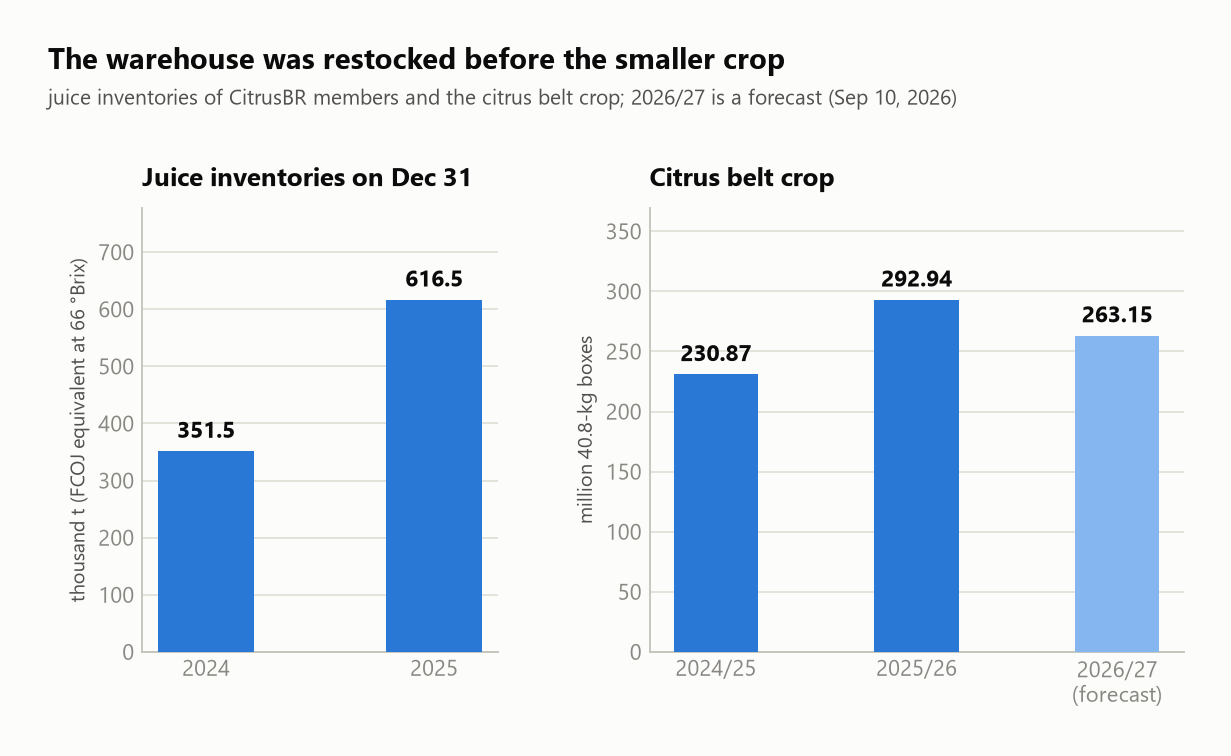
As a result, inventories held by CitrusBR member companies were rebuilt: 616 thousand metric tons on December 31, 2025, up 75% from 2024 and the highest level since 2020. [4] The forecast of a smaller 2026/27 crop, released in May 2026 (−12.9%), arrived when the warehouse was no longer empty, and it did not support prices; in September, the forecast was revised upward, to 263.15 million boxes (−10.2% from 2025/26). [1,2]
For growers, a box of oranges delivered to the processing plant was worth R$27.43 on October 22, 2026, 45% less than a year earlier. Even in an irrigated grove in northern São Paulo that harvests 1,000 boxes per hectare, well above the average forecast for the citrus belt (697), that price covers only about half of the total cost. [2,5,6]
From scarcity to rebuilt stocks
| date | US$ per pound solids | change from the Dec 19, 2024 peak |
|---|---|---|
| Dec 19, 2024 (peak) | 5.48 | peak |
| Mar 31, 2025 | 2.44 | −56% |
| Sep 22, 2025 | 2.39 | −56% |
| Oct 21, 2025 | 1.86 | −66% |
| Nov 24, 2025 | 1.37 | −75% |
| Jan 28, 2026 | 2.27 | −59% |
| Sep 22, 2026 | 1.53 | −72% |
| Oct 22, 2026 | 1.40 | −74% |
Closes of the front-month frozen concentrated orange juice (FCOJ) contract on ICE Futures U.S. We use only trading sessions with at least 300 contracts traded: near expiry, the front-month contract barely trades and its price is distorted. In September 2024, for example, there are closes above US$5.48 with 1 to 4 contracts. By the same criterion, the year-earlier row is Oct 21, 2025: on the 22nd, only 269 contracts were traded. Between these dates, the price swung: the table includes the lowest close of Oct–Dec 2025 and the highest of Jan–Mar 2026. Near expiries, the front-month series mixes contracts, and those days are left out of the comparisons: on Sep 10, 2026, for example, it shows US$1.26 from the expiring September contract, while the November contract closed at US$1.44. [1]
Why didn't the smaller 2026/27 crop lift the price? Think of a warehouse. In 2024 it was nearly empty: inventories held by CitrusBR members ended the year at 351 thousand metric tons, the lowest level in a series that began in 2011, during a 2024/25 crop that Fundecitrus recorded as the second smallest in 37 years. [2,4] The price soared.
Then supply returned: the 2025/26 crop grew 26.9%. And customers pulled back: according to AC Nielsen data published by the Florida Department of Citrus and cited by Rabobank in September 2026, in the current season juice cost 8.5% more on American store shelves and the volume sold was 6.4% lower than in the previous season. [2,3]
In May 2026, when Fundecitrus forecast a 2026/27 crop 12.9% smaller, the warehouse had already been restocked. The price, which stood at US$1.89 in April (median of the month's trading sessions), stayed between US$1.34 and US$1.60 from July to October 22. In September, the forecast was revised upward (+3.1%). [1,2] This is our reading of the data; it does not rule out other factors, such as the exchange rate and tariffs.
The two sides of supply
| measure | before | after | change |
|---|---|---|---|
| Juice inventories of CitrusBR members on Dec 31 (thousand t, FCOJ equivalent at 66 °Brix) | 351.5 (2024) | 616.5 (2025) | +75.4% |
| Citrus belt crop (million 40.8-kg boxes) | 230.87 (2024/25) | 292.94 (2025/26) | +26.9% |
| Citrus belt crop (million 40.8-kg boxes) | 292.94 (2025/26) | 263.15 (2026/27, forecast of Sep 10, 2026) | −10.2% |
These are the inventories of CitrusBR member companies, wherever in the world they are held, combining frozen concentrated orange juice (FCOJ) and not-from-concentrate juice (NFC), converted to FCOJ equivalent at 66 °Brix, as compiled by an external auditor. [4] The 2025 figure is the highest since 2020 (679 thousand metric tons), but it is still below the 2011–2024 average (about 711 thousand metric tons): the warehouse was restocked, not overflowing. In September 2026, Rabobank reported that, in the market's view, inventories had returned to near-normal levels. [3,4]
The crop is that of the citrus belt of São Paulo and the Triângulo/Southwest Minas Gerais. The 2026/27 figure is a forecast: the first one, in May, was 255.2 million boxes; the September one rose to 263.15 million, and Fundecitrus's next revision is scheduled for December 10. [2]
In the United States, frozen concentrated orange juice in cold storage totaled 501 million pounds on August 31, 2026, 71% more than a year earlier. The measure is juice at 42 °Brix and is not directly comparable with CitrusBR's metric tons at 66 °Brix. [7]
On the demand side, the same Rabobank report notes that, in the preceding weeks, US retail prices had begun to stabilize and volumes were showing more stability. [3]
And the juice's destination changed. In the 2025/26 crop year, the United States received almost 48% of the juice exported through the port of Santos, and the European Union about 45%; in the previous crop year, Europe was the main destination. Total volume was stable (746.9 thousand metric tons, +0.2%), but revenue fell about 30%, to US$2.38 billion. [8]
The squeezed grower
| measure | R$ per 40.8-kg box |
|---|---|
| Oranges delivered to the processor, Oct 22, 2025 | 50.05 |
| Oranges delivered to the processor, May 2026 | ≈ 25 |
| Oranges delivered to the processor, August 2026 | ≈ 31 |
| Oranges delivered to the processor, Oct 22, 2026 | 27.43 |
| Break-even price, irrigated high-density grove in northern São Paulo (2026/27 crop), at 1,000 / 800 / 600 boxes/ha | 53.5 / 63.1 / 79.0 |
| Break-even price, rain-fed grove in south-central São Paulo (2026/27 crop), at 1,000 / 800 / 600 boxes/ha | 45.6 / 52.7 / 64.5 |
Oranges delivered to the processor: spot-market price (outside contracts), with deferred payment, from the Cepea series; May and August 2026 as cited by Rabobank. Break-even price: the price that covers the total cost (operating costs, depreciation and return on capital) at each yield, according to Cepea. Fundecitrus's average yield forecast for the citrus belt in 2026/27 is 697 boxes per hectare. [2,3,5,6]
Over 12 months, the box sold to processors fell 45%. On October 22, even at 1,000 boxes per hectare, the price covered only about 60% of the rain-fed grove's break-even price and about half of the irrigated grove's. At 800 boxes per hectare, closer to the citrus belt's forecast average, it covered about 52% and 43%. [2,5,6]
The time window changes the conclusion. From May to August 2026, the box price rose, from about R$25 to R$31; from August to October 22, it fell again, to R$27.43. Picking a single window tells half the story. [3,5]
In September, Rabobank summed it up: the spot price remains below production costs for a significant share of growers. [3] And the impact is uneven. According to Cepea, at a large share of processors, crushing has concentrated on fruit under existing contracts, which has reduced spot-market purchases; and, with fruit quality below normal, even contracted fruit has been subject to discounts on final prices. [5] As we read it, each grower's outcome depends on the contract, costs and debt.
The tariff risk
On July 22, 2026, a 25% additional US tariff on Brazilian products took effect, the result of a Brazil-specific investigation under Section 301 of US trade law. Orange juice was excluded and remains subject only to the standard US tariff. [9]
A second Section 301 measure, aimed at countries that the United States considers not to be combating imports made with forced labor, created an additional 12.5% tariff. Juice is among the 471 exempt Brazilian products; for products with no exemption under either measure, the additional tariffs add up to 37.5%. [9,10]
An exemption that was granted is an exemption that can be revoked. And dependence on the US market has grown: almost half of the juice exported in 2025/26 went to the United States. [8] Rabobank also points to another risk, that of possible Brazilian tariff retaliation against the US measures. [3]
Tariff measures change often. The page of Brazil's trade ministry (MDIC) that tracks these measures was updated on October 26, 2026: check it before making decisions. [9]
The map is changing
A Rabobank projection, reported by the press in May 2025, estimated that the orange area in Mato Grosso do Sul, Minas Gerais outside the Triângulo and Paraná would reach 73 thousand hectares in 2025/26 and 100 thousand by 2028/29. [11] In 2024, Embrapa and Fundecitrus published Zarc Citros, a climate-risk zoning for this "expanded citrus belt," which includes neighboring states such as Goiás, Mato Grosso do Sul and Paraná. [12]
Moving to a new region, however, does not guarantee escaping greening. Paraná, one of the destinations, had been under a phytosanitary emergency for the disease since December 2023, according to Adapar in April 2025; by August 2024, greening had already been detected in about 160 of the state's municipalities. [13]
Rio Grande do Sul confirmed its first cases on June 8, 2026, in a backyard orchard in Palmitinho. The outbreak was eradicated on June 11, but, over 45 days of surveillance, up to the update released on July 23, 87 samples tested positive in the municipality, and samples from a second outbreak, in Caiçara, were still being analyzed. The response follows the National Program for the Prevention and Control of HLB (SDA/MAPA Ordinance No. 1326, dated July 4, 2025). [14]
And there is the cost of staying. In the citrus belt, fruit drop caused by greening took 49.59 million boxes out of the 2025/26 crop, almost double the roughly 25 million of 2024/25, according to Fundecitrus. [2] And production costs rose again in the 2026/27 crop year: 8.3% for the irrigated grove and 9.6% for the rain-fed one, driven partly by biological insecticides against the psyllid, the insect that transmits the disease. [6]
A gap we should disclose: we looked for data on realized yields (boxes per hectare) in the new regions and did not find a reliable source. Reports deal with planted area and investment plans, not harvested yields.
What to expect from 2027
1. What the data support
- Inventories have been rebuilt and US consumption remains weak, with the first signs of stabilization. [3,4]
- The 2026/27 crop is forecast at 263.15 million boxes; Fundecitrus's next revision comes out on December 10. [2]
- According to the US climate agency NOAA, El Niño is already under way and strengthening. On October 8, 2026, it considered a strong to very strong event likely through January–March 2027 and gave an 83% chance that, in October–December, it would exceed the strength of every El Niño recorded since 1950. Rabobank says heat and dry spells could affect part of the flowering for the 2027/28 crop. [3,15]
2. Scenarios (high uncertainty)
- Scenario A (comfortable supply and weak consumption). If US consumption does not recover and the 2026/27 crop is confirmed, inventories will keep weighing on prices and growers' margins.
- Scenario B (weather and a demand recovery). If El Niño damages the flowering for the 2027/28 crop and consumption stabilizes, the price could gradually recover; that is what Rabobank expected in September, over the course of 2026/27. [3]
We do not forecast prices. There is not enough evidence today to say which of the two scenarios will prevail.
3. What nobody knows
How long American consumers will take to come back, if they do. It is the variable that governs everything else, and the available data show only the first signs of stabilization.
About this analysis
This is a Nexus4AI trend analysis, bringing together data from public agencies (USDA, NOAA, MDIC, Adapar, the Rio Grande do Sul state government), from industry bodies (Fundecitrus, CitrusBR) and from Cepea/Esalq-USP, futures prices redistributed by a publicly accessible data provider, a bank report and the trade press. The research, organization and cross-checking are our own. This is not investment advice, crop-marketing advice or a legal opinion.
Market figures are as of October 22, 2026 or earlier. Sources were checked through November 7, 2026; two of them are later than the cut-off and do not change the figures in the text: the MDIC page, updated on October 26, and the Cepea analysis of October 28.
Every figure on this page has a linked source in the references below; where the source is the press, we say so. Where we did calculations (changes, averages, comparisons with the break-even price), the calculation is described in the text.
Corrections are welcome, including when they contradict us, and will be recorded.
References
- ICE Futures U.S.: daily closes of the front-month frozen concentrated orange juice (FCOJ) contract, in US cents per pound solids, as redistributed by Yahoo Finance, accessed on Nov 7, 2026. Criterion: trading sessions with at least 300 contracts traded. To check contract rolls, we also used the November 2026 contract (OJX26), from the same source.
- Fundecitrus: final figures for the 2024/25 crop, Apr 10, 2025 (230.87 million boxes; about 25 million lost to fruit drop caused by greening); final figures for the 2025/26 crop, Apr 10, 2026 (49.59 million boxes lost to fruit drop caused by greening); executive summary of the 2026/27 crop forecast, May 8, 2026 (2025/26 crop closed at 292.94 million boxes; initial forecast of 255.2 million, −12.9%; average yield of 697 boxes per hectare); first re-estimate of the 2026/27 crop, Sep 10, 2026 (263.15 million 40.8-kg boxes, +3.1% over the May estimate).
- Rabobank: Brazil Agribusiness Quarterly Q3 2026, September 2026, p. 21: Cepea prices for May and August, AC Nielsen data from the Florida Department of Citrus, inventories, El Niño and the risk of tariff retaliation.
- CitrusBR: market notice of Mar 4, 2026, with member inventories on Dec 31 from 2011 to 2025.
- Cepea/Esalq-USP: oranges delivered to the processor, with deferred payment, series reproduced by Notícias Agrícolas: R$50.05 on Oct 22, 2025 and R$27.43 on Oct 22, 2026; and analysis of contracts and spot purchases, Oct 28, 2026.
- Cepea/Esalq-USP, Hortifruti Brasil No. 266 (Especial Citros 2026, May 2026), as reported by Broto, May 16, 2026 (press): cost increases and break-even prices by yield.
- USDA NASS: Cold Storage, Sep 25, 2026 (frozen concentrated orange juice on Aug 31, 2026, adjusted to 42 °Brix: 501,044 thousand pounds, 171% of the previous year).
- Secex, data compiled by CitrusBR: orange juice exports in the 2025/26 crop year through the port of Santos, according to eaemaq, Jul 9, 2026 (press).
- Brazil's Ministry of Development, Industry, Trade and Services (MDIC): scope of the US tariff measures on Brazilian exports (in Portuguese), Jul 24, 2026, updated on Oct 26, 2026.
- Agência Brasil: 471 Brazilian products are exempt from the new 12.5% tariff imposed by the United States (in Portuguese), republished by B3 Bora Investir, Jul 24, 2026 (press).
- The AgriBiz: fleeing greening, oranges test new frontiers (in Portuguese), May 22, 2025 (press): Rabobank area projection.
- Embrapa and Fundecitrus: Zarc Citros, climate risks in expansion regions of the citrus belt, Jul 25, 2024.
- Adapar: phytosanitary emergency since December 2023, Apr 30, 2025; and about 160 municipalities with the disease, Aug 15, 2024.
- Rio Grande do Sul state government: confirmation of the first cases, Jun 9, 2026, and eradication of the outbreak in Palmitinho, Jun 11, 2026; update on 45 days of surveillance by Rádio Alto Uruguai, with information from Correio do Povo, Jul 23, 2026 (press; the same update was published on the Afagro website, which was offline on Nov 7, 2026); SDA/MAPA Ordinance No. 1326, dated July 4, 2025, copy published by Idaf-ES.
- NOAA, Climate Prediction Center: ENSO Diagnostic Discussion of Oct 8, 2026.
The values in each chart are also in the table right below it, so they can be read without relying on color.
Nexus4AI · nexus4.ai · Data cut-off: October 22, 2026