Cocoa Panorama 2026/2027 — The Market
Nexus4AI · Original analysis · Data cut-off: October 25, 2026 8-minute read
⏱️ The figures on this page have an expiry date. New York futures prices, the exchange rate and the physical price per arroba change every day. Everything here is valid as of the cut-off date (October 25, 2026) and should be rechecked against the primary sources, linked in the references, before any commercial or financial decision. An example of how much this matters: on the first business day after the cut-off, October 26, the PTAX dollar rate went from R$5.0377 to R$5.5007 (+9.2%), and the conversion of New York prices into reais shifted by the same proportion. [2]
Summary
Between 2024 and 2026, the price of cocoa climbed to a record and then lost more than half of its value. On the New York exchange, the close reached US$12,565 per tonne on December 18, 2024, fell to US$2,798 on February 27, 2026 and stood at US$5,592 on October 23, 2026 (December 2026 contract). The price is 55.5% below the peak, but it has practically doubled since the February low and is still worth about 2.2 times the 2013–2022 average (US$2,553). [1]
In the physical market of Ilhéus, the price per 15 kg arroba followed the same path. In the daily series of the Bahia State Department of Agriculture (SEAGRI-BA), the quote reached R$1,029.00 on December 17, 2024, the highest value recorded since 2015, and the monthly average fell from R$920.44 in December 2024 to R$172.80 in March 2026. In October 2026, the sources diverge: on the same day, October 22, SEAGRI recorded R$230.00 (common cocoa, Ilhéus) and Mercado do Cacau R$278.00 (conventional, Bahia); on October 23, Mercado do Cacau quoted R$272.00. [7, 8]
The world balance changed sign, but for the reason that hurts the industry most. After a deficit of 492 thousand tonnes in the 2023/24 cocoa year, the International Cocoa Organization (ICCO) estimates a small surplus for 2024/25: 48 thousand tonnes in the May 2026 bulletin and 37 thousand in the August one. It came both from the partial recovery of the harvest and from the fall in world grindings, which shrank for the second year in a row. [3]
In Brazil, the industry received 226,497 tonnes of domestic cocoa beans in the 2025/26 crop year (+25.3%) and imported 57.1% less from January to September 2026. Outside the traditional regions, irrigated full-sun cocoa is advancing in Western Bahia, and Espírito Santo increased its deliveries to the industry by 68.5% in 2025. [5, 6, 10]
From the 2024 fever to the 2026 adjustment
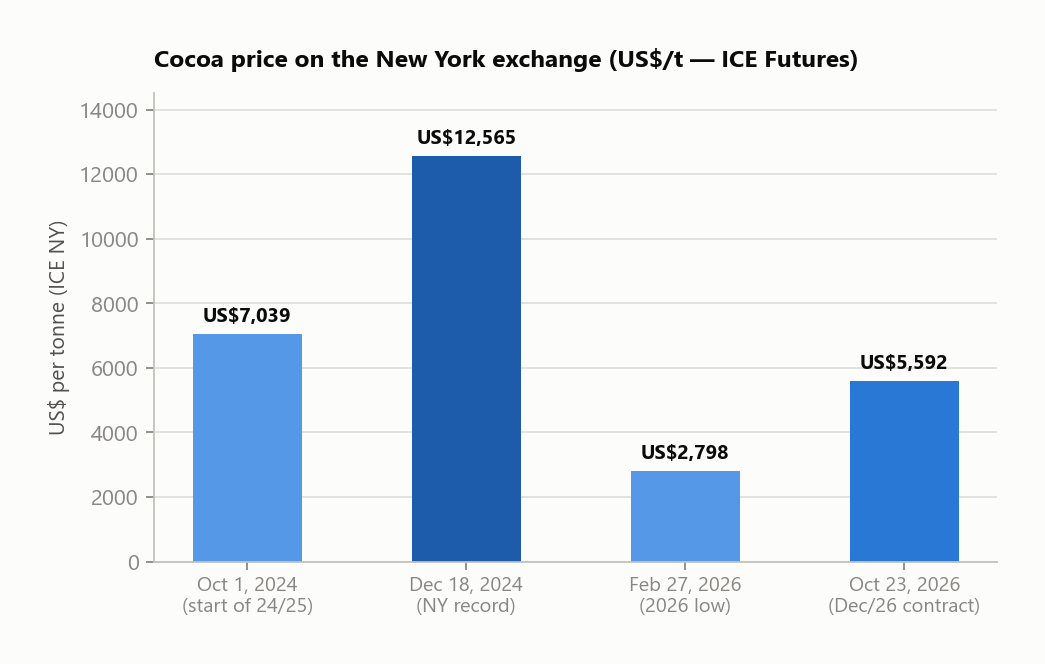
| date | New York price (US$ per tonne) | change from the Dec 18, 2024 peak |
|---|---|---|
| Oct 1, 2024 (start of the 2024/25 cocoa year) | 7,039 | −44.0% |
| Dec 18, 2024 (record close; intraday high of US$12,931) | 12,565 | peak |
| Feb 27, 2026 (lowest close of 2026) | 2,798 | −77.7% |
| Oct 23, 2026 (December 2026 contract; March 2027 at US$5,691) | 5,592 | −55.5% |
Closes of the front-month contract on ICE Futures U.S.; on Oct 23, 2026, the December 2026 contract. On Feb 27, 2026, the front-month contract (March 2026) was already in its delivery period and saw almost no trading; May 2026, the most traded, closed at US$2,888. [1]
What caused the 2024 surge, and why did the price fall so far afterwards? [1, 3, 4]
About half of the world's cocoa comes from two neighboring countries in West Africa, Côte d'Ivoire and Ghana: 51% in 2023/24 and 57% to 58% in the two previous years, according to ICCO figures. In 2023/24, unfavorable weather, diseases and old, low-yielding trees cut world production by about 660 to 685 thousand tonnes (−13% to −14%) in a single year (662 thousand t in the November 2024 bulletin; 685 thousand t with the revisions published up to May 2026), with the loss concentrated in those two countries. [3]
When raw material runs short in a chain that cannot plant new trees overnight (a new cocoa tree takes years to start producing), the price rises until it destroys part of demand. The decline that followed went beyond an adjustment: in February 2026, the close reached US$2,798, and since then the price has almost doubled. In October, Barchart attributed the rise to smaller port arrivals in Côte d'Ivoire (see below). [1, 4]
The world balance according to the ICCO
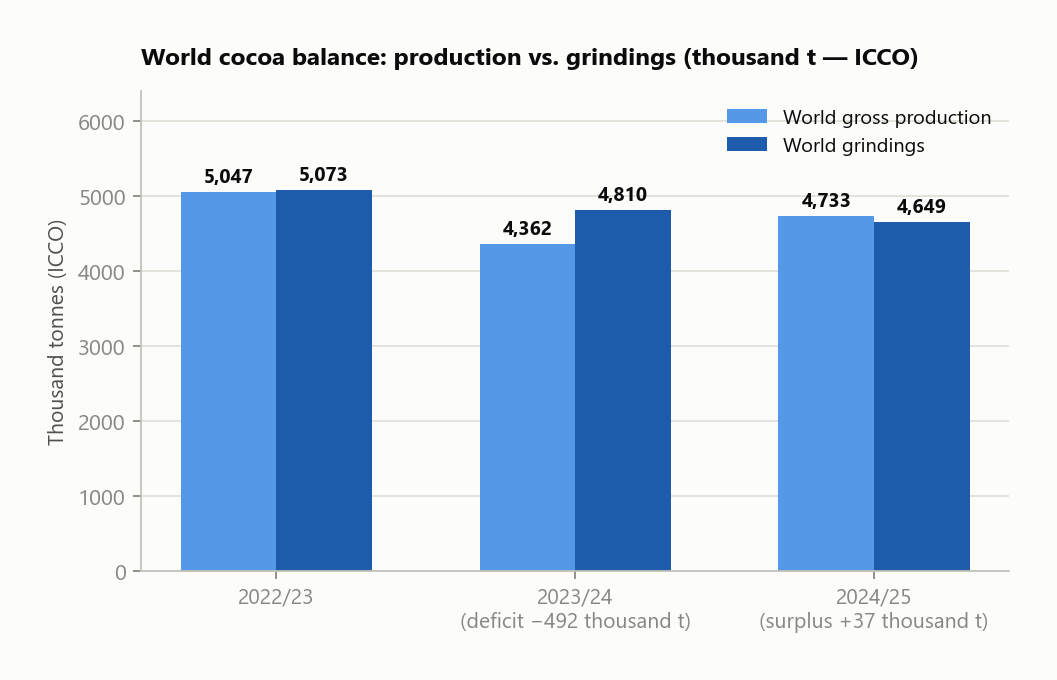
| cocoa year (Oct–Sep) | world gross production (thousand t) | world grindings (thousand t) | surplus/deficit (thousand t) | end-of-season stocks (thousand t) | stocks-to-grindings ratio |
|---|---|---|---|---|---|
| 2022/23 (May 2024 bulletin) | 5,047 | 5,073 | −76 | 1,767 | 34.8% |
| 2023/24 (May 2026 bulletin) | 4,362 | 4,810 | −492 | 1,272 | 26.4% |
| 2024/25 (May 2026 bulletin) | 4,723 | 4,628 | +48 | 1,320 | 28.5% |
| 2024/25 (August 2026 bulletin) | 4,733 | 4,649 | +37 | 1,309 | 28.2% |
(Note: the ICCO balance deducts from gross production the physical loss in weight, about 1% according to the arithmetic of the table itself, before subtracting grindings. In the August 2026 bulletin, the ICCO temporarily withheld production and grindings data for the 2025/26 cocoa year.) [3]
Look at the grindings and stocks columns of the table:
- Between 2022/23 and 2024/25, world grindings shrank by more than 420 thousand tonnes (from 5,073 to between 4,628 and 4,649 thousand t). With cocoa butter and cocoa liquor at prohibitive prices, global chocolate demand fell, and grindings declined in Europe and North America. [3, 14]
- Despite the small surplus of 37 to 48 thousand tonnes in 2024/25, world stocks (1,309 to 1,320 thousand t) remain about 450 thousand tonnes below the 2022/23 level (1,767 thousand t). That is why news about the pace of port arrivals in Côte d'Ivoire still moves prices in New York. From October 1 to 18, 2026, Ivorian farmers delivered 78,212 t to the ports, 41% less than the 133,209 t of the same period of 2025, according to the country's government data reported by Barchart on October 19. In the same week, the December 2026 contract fell US$261 in a single session (October 22). [1, 4]
Brazil in 2026: more beans on the farm, industry still cautious
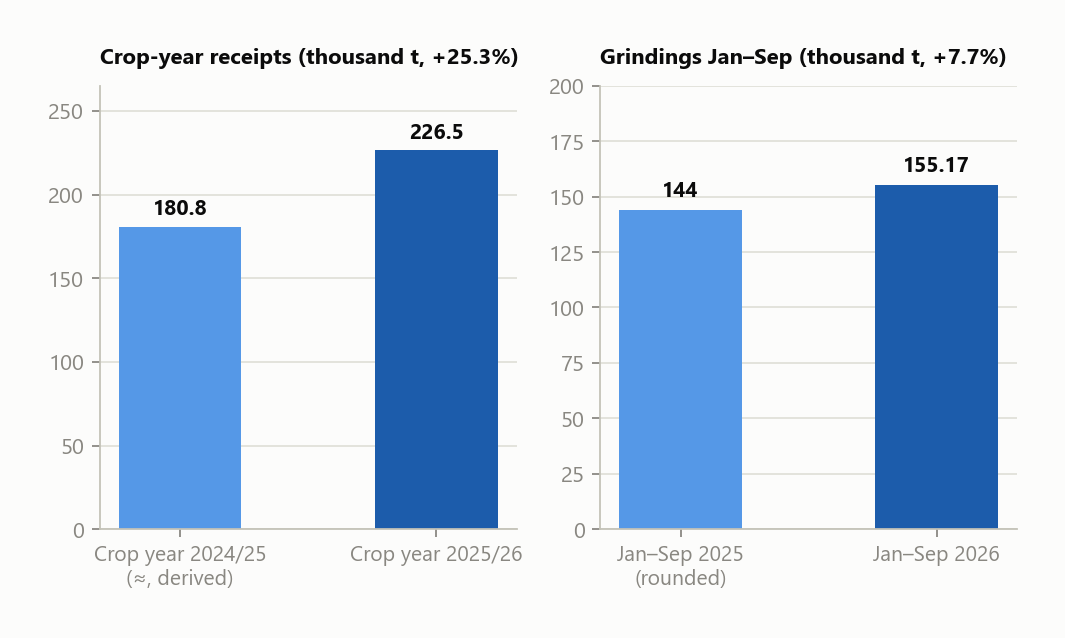
| indicator in Brazil (AIPC / SindiDados, released on Oct 9, 2026) | previous period | current period | change |
|---|---|---|---|
| Bean receipts in the crop year (Oct–Sep) | ≈ 180.8 thousand t (2024/25)¹ | 226,497 t (2025/26) | +25.3% |
| Receipts in Q3 (Jul–Sep) | 68,212 t (Q3 2025) | 71,652 t (Q3 2026) | +5.0% (largest Q3 in the 2023–2026 series) |
| Cumulative grindings for the year (Jan–Sep) | 144 thousand t (Jan–Sep 2025)² | 155,169 t (Jan–Sep 2026) | +7.7% vs. 2025 (−8.6% vs. 2024; −18.5% vs. 2023) |
| Grindings in Q3 (Jul–Sep) | 46.1 thousand t (Q3 2025)² | 53,743 t (Q3 2026) | +16.4% vs. Q3 2025 (+8.1% vs. Q2 2026) |
| Bean imports (Jan–Sep) | ≈ 42.1 thousand t (Jan–Sep 2025)¹ | 18,068 t (Jan–Sep 2026) | −57.1% |
| Exports of derivatives (Jan–Sep) | ≈ 40.0 thousand t (Jan–Sep 2025)¹ | 44,050 t (Jan–Sep 2026) | +10.2% (+54.3% in Q3 2026, with 17,311 t) |
¹ AIPC released only the percentage change; the value for the previous period was calculated by us from it. ² Rounded value, as AIPC released it in October 2025. The changes in the table are AIPC's own, calculated on the exact figure; that is why 53,743 ÷ 46,100 gives 16.6%, not 16.4%. [5, 6]
The October 2026 data from AIPC (Associação Nacional das Indústrias Processadoras de Cacau, Brazil's national association of cocoa processors) tell of two opposite movements that need to be read together: [5, 6]
- Domestic supply has responded. After the 2024 crop shortfall (179,431 t received in the calendar year), receipts for the 2025/26 crop year reached 226,497 tonnes (+25.3% over the 2024/25 crop year). AIPC does not point to the cause of the increase; more favorable weather and crop management encouraged by the high prices of 2024/25 probably contributed, but this is our inference. With more domestic cocoa in the factories, grinders cut bean imports by more than half (−57.1%), all of which arrived in Q1: there were no imports in Q2 or Q3. [5, 6]
- Grindings have not yet returned to pre-crisis levels. Although they grew 7.7% from January to September 2026 (155,169 t) over the 2025 low, processing remains 18.5% below the same period of 2023. On a full-year basis, grindings were 253,507 t in 2023, 229,334 t in 2024 and 195,882 t in 2025. In the words of AIPC's executive president, Anna Paula Losi, "demand for derivatives needs to recover on a sustained basis" (our translation). [5, 6]
The farmer's bottom line and the Brazilian discount
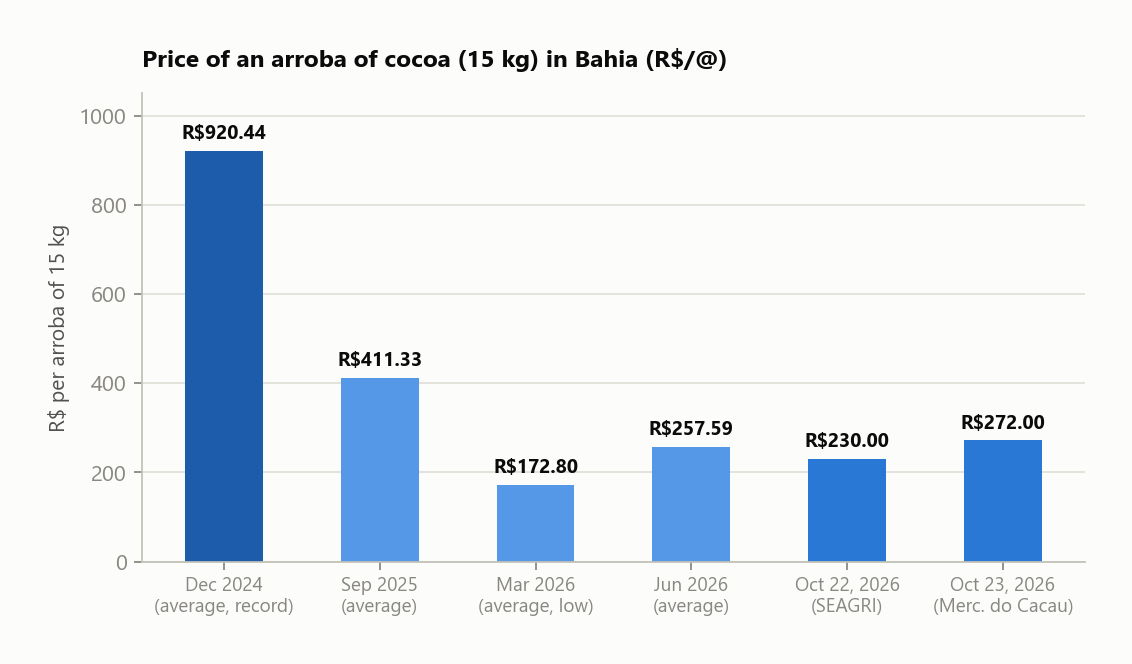
| reference | price per arroba of 15 kg (R$) | note and source |
|---|---|---|
| Aug 2017 (monthly average) | 98.65 | lowest monthly average in the Ilhéus series since 2016 — SEAGRI-BA [7] |
| Dec 2024 (monthly average) | 920.44 | highest monthly average in the series; daily high of R$1,029.00 on Dec 17, 2024 — SEAGRI-BA [7] |
| Sep 2025 (monthly average) | 411.33 | only 9 quotes published in the month — SEAGRI-BA [7] |
| Dec 2025 (monthly average) | 390.76 | SEAGRI-BA [7] |
| Mar 2026 (monthly average) | 172.80 | lowest monthly average of 2026; daily low of R$150.00 (Feb 27 and Mar 2, 2026) — SEAGRI-BA [7] |
| Jun 2026 (monthly average) | 257.59 | partial recovery; SEAGRI did not publish Ilhéus quotes from Jul 8 to Oct 20, 2026 [7] |
| Oct 22, 2026 (Ilhéus, common cocoa) | 230.00 | SEAGRI-BA [7] |
| Oct 23, 2026 (Bahia, conventional) | 272.00 | certified (the source's "Base Indústrias" price): R$348.00 — Mercado do Cacau [8] |
Monthly averages calculated by us from the daily Ilhéus quotes (common cocoa) published by SEAGRI-BA. The two October sources do not match and are shown side by side on purpose. [7, 8]
Two figures from October 23, 2026 stand out for the producer:
- The discount to New York. With New York at US$5,592/t and the PTAX dollar at R$5.0377, the mathematical parity is R$28,171 per tonne, or R$422.56 per arroba. Conventional cocoa from Bahia traded at R$272.00 per arroba (@) in the Mercado do Cacau quote, a discount of about 36% to parity. Using SEAGRI's quote from the previous day (R$230.00, against a parity of R$421.86), the discount exceeds 45%. Part of this gap comes from financial carrying costs, taxes, logistics and quality standards; how much falls to each factor was not measured here. In Pará, conventional cocoa traded at R$16.00 per kilo (R$240/@). [1, 2, 7, 8]
- The certification and quality premium. On the same date, certified cocoa (the source's "Base Indústrias" price) traded at R$348.00/@ in Bahia and R$23.00/kg in Pará: premiums of +28% and +44% over conventional cocoa in each state. [8]
The map is changing: full sun in the Cerrado and the Europe factor (EUDR)
In Bahia, where traditional shaded cultivation predominates, average yield was 322 kg per hectare in 2025 (about 21 arrobas); in Pará, 901 kg/ha (about 60 arrobas), according to IBGE's Municipal Agricultural Production survey. Outside the Atlantic Forest and the Amazon, irrigated and mechanized commercial cocoa farming under full sun has been expanding: [9]
- Western Bahia. According to SEAGRI-BA, farms in the region already reach 3,000 to 3,500 kg per hectare (200 to 233 arrobas), 9 to 11 times the Bahia average. The climate, with a long dry season, tends to reduce pressure from humidity-related fungal diseases such as witches' broom and black pod; this is our agronomic inference, not a comparative measurement. [9, 10]
- Espírito Santo. The volume delivered to the industry grew 68.5% from 2024 to 2025 (from 5,968 to 10,054 tonnes). The figure is the state total and does not separate irrigated full-sun cocoa from shaded cocoa. [6]
Caveat: the 3,000 to 3,500 kg/ha in Bahia's Cerrado come from high-input, irrigated, full-sun projects with high initial investment per hectare, and are a figure released by the state agriculture department, not an independent measurement. We found no independent long-term monitoring (10 years or more) of the longevity of these plants under the Cerrado's sun exposure, nor an audited average cost per arroba. [10]
The European regulatory window (EUDR)
The European Union Deforestation Regulation (EUDR, Regulation (EU) 2023/1115) requires the geolocation of each plot of land (as a polygon when the plot exceeds 4 hectares) and proof that no deforestation took place after December 31, 2020, for cocoa and derivatives to be sold on the European market. After two postponements, the rule takes effect on December 30, 2026 for medium and large companies and on June 30, 2027 for most micro and small ones; the review report published by the European Commission on May 4, 2026 kept these dates. Brazil is classified as a standard-risk country, not a low-risk one. [11]
For Brazilian cocoa, the rule is both a compliance cost and an opportunity: Bahia's cabruca and the Amazonian agroforestry systems keep the forest standing, which tends to make the required proof easier. That this could translate into a price advantage is our own assessment; it has not yet been observed in the market.
Scenarios for 2027 (and what separates observed data from projection)
Unlike reports that sell firm price forecasts, here we separate what is supported by observed data from what depends on open variables.
1. What current data support (high confidence about the starting point):
- Brazil enters 2027 with greater domestic supply than in 2024 and 2025 (226.5 thousand t in the 2025/26 crop year), less dependence on imported beans (−57.1% from January to September) and a sizeable premium for certified cocoa (+28% over conventional in Bahia on Oct 23, 2026). [5, 8]
- In the world market, the stocks-to-grindings ratio (28.2% in the ICCO's August 2026 bulletin) remains well below the 34.8% of 2022/23. The global market still has no comfortable cushion against weather-driven crop shortfalls in West Africa. [3]
2. Conditional price scenarios for 2027 (high uncertainty):
- Scenario A (African recovery and weak demand). If rains in West Africa stabilize the 2026/27 crop and world grindings stay subdued, the New York price would tend to stay far from the 2024 peak. We do not forecast a price range. To translate any price into arrobas: at the exchange rate and discount of Oct 23, 2026, each US$1,000/t in New York is equivalent to about R$49/@ in Bahia's conventional physical market.
- Scenario B (West African crop shortfall and El Niño). The 41% drop in Ivorian port arrivals in early October may be just a delay (heavy rains cut off roads, according to Barchart) or the first sign of a smaller main crop. Add El Niño: the US climate agency NOAA has maintained an El Niño Advisory since June 2026 and, in its October 8 bulletin, considered a strong to very strong event likely through January–March 2027, with an 83% chance of it being the most intense since 1950 in the October–December quarter. The phenomenon usually brings warmer, drier weather to West Africa, and in Brazil the El Niño panel of INMET and other federal agencies forecast below-average rainfall for most of the Northeast in July–September 2026. With tight stocks, this picture may trigger a new rally. There is not enough evidence today to say which of the two scenarios will prevail. [4, 12, 13]
About this analysis
This is a trend analysis by Nexus4AI that brings together bulletins from the ICCO, industrial statistics from AIPC / SindiDados, official quotes from SEAGRI-BA and the Central Bank of Brazil, agricultural statistics from IBGE and market prices (ICE Futures U.S. and Mercado do Cacau). The research, organization and cross-checking are ours. It is not a recommendation on investment, futures hedging or agricultural trading, nor a legal opinion.
Every figure on this page has a source with a link in the references below. Where we did calculations (monthly averages, parity, discount, shares), the calculation is described in the text. Where two sources disagree, we show both.
Corrections are welcome, including when they contradict us, and will be recorded.
References
- ICE Futures U.S.: daily closes of New York cocoa (front-month contract; December 2026 and March 2027 contracts), as redistributed by Yahoo Finance, accessed on Nov 3, 2026. The 2013–2022 average is the average of the front-month contract's daily closes, calculated by us. The close of the May 2026 contract on Feb 27, 2026 (US$2,888) is from Notícias Agrícolas, accessed on Nov 4, 2026.
- Central Bank of Brazil: PTAX dollar rate, closing bulletin (selling rate: R$5.0383 on Oct 22, 2026, R$5.0377 on Oct 23, 2026 and R$5.5007 on Oct 26, 2026), accessed through the Olinda API on Nov 3, 2026.
- ICCO, Quarterly Bulletin of Cocoa Statistics: February 2024 (causes of the 2023/24 crop shortfall); Vol. L No. 2, May 31, 2024 (2022/23 cocoa year); Vol. L No. 4, Nov 29, 2024, production table by country (Côte d'Ivoire and Ghana); Vol. LII No. 2, May 29, 2026 (2023/24 and 2024/25 cocoa years); Vol. LII No. 3, August 2026 (2024/25 cocoa year and withholding of the 2025/26 data).
- Barchart (Rich Asplund): Cocoa Prices Rebound on Smaller Ivory Coast Deliveries, Oct 19, 2026. Côte d'Ivoire port arrivals (Ivorian government data), rains and the typical El Niño effect in West Africa.
- AIPC / SindiDados – Campos Consultores: Q3 2026 and 2025/26 crop-year report, released on Oct 9, 2026.
- AIPC / SindiDados – Campos Consultores, earlier reports: Q3 2025 (Oct 15, 2025); 2024 year-end; 2025 year-end and receipts by state in 2025.
- SEAGRI-BA: agricultural price quotes, cocoa, daily series for Ilhéus (common cocoa, R$ per arroba of 15 kg), accessed on Nov 3, 2026. The monthly averages were calculated by us.
- Mercado do Cacau, via Notícias Agrícolas, Cotação Cacau BR, closes of Oct 22, 2026 and Oct 23, 2026.
- IBGE: Municipal Agricultural Production, table 1613 (cocoa beans, average yield in 2025), accessed through the aggregates API on Nov 3, 2026.
- SEAGRI-BA, cited by Movimento Econômico, Sep 14, 2026: cocoa yields in Western Bahia.
- European Union: Regulation (EU) 2023/1115 (Art. 9, geolocation of plots); Commission report COM(2026) 191, May 4, 2026 (application dates after the December 2025 review); Implementing Regulation (EU) 2025/1093 (risk classification by country).
- NOAA, Climate Prediction Center: ENSO Diagnostic Discussion of Jun 11, 2026 and Oct 8, 2026.
- INMET and partner federal agencies: El Niño Panel 2026–2027, June 2026 bulletin.
- FoodNavigator: Sales stall, shares fall: What's next for Barry Callebaut?, Apr 20, 2026.
The values in each chart are also given in the table just below it, for reading without relying on color.
Nexus4AI · nexus4.ai · Data cut-off: October 25, 2026